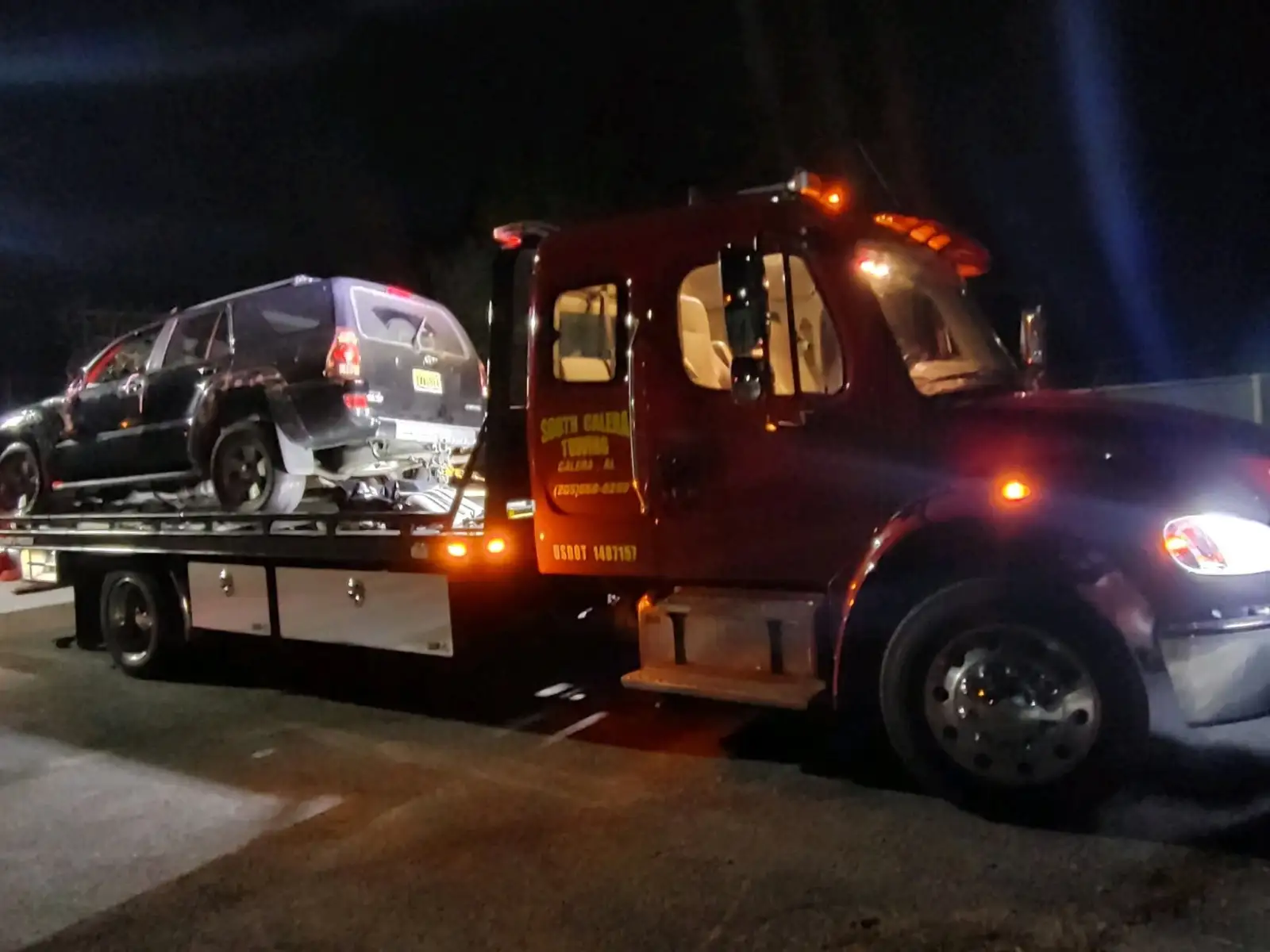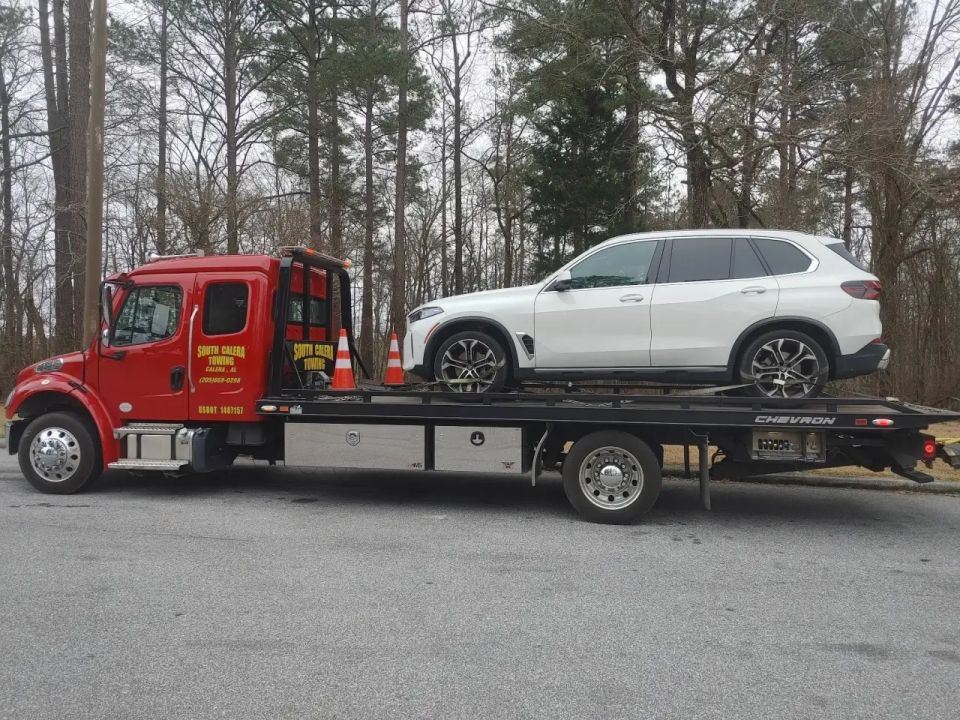
When you call for a tow, we ask what you drive. That’s not small talk – it decides which truck we send. Most of our tows ride on a flatbed (rollback), but our wheel-lift wrecker has its place too.
The flatbed (rollback)
The whole bed tilts and slides back to the ground. The car is pulled up with a winch or driven on, then strapped at the wheels. All four wheels ride off the road.
- Best for: all-wheel drive and 4×4, electric cars and hybrids, luxury and low cars, cars that won’t roll after a wreck, long trips – and equipment like skid steers and forklifts.
- Downside: needs room behind the car to tilt the bed, so tight parking decks can be a problem.
The wheel lift
A metal arm slides under the front or rear wheels and lifts that end, and the vehicle rolls on its other two wheels. It is the modern version of the old hook and chain, and it doesn’t touch the bumper.
- Best for: tight spots, short tows of two-wheel-drive cars, and vehicles too long or tall for the bed – like the box truck we towed with our wrecker.
- Downside: two wheels turn on the road the whole way, which some drivetrains can’t take.
Which vehicles must go on a flatbed?
- AWD and full-time 4×4 – towing with two wheels down can damage the center differential or transfer case.
- Electric cars – the motors turn when the wheels turn; most manufacturers say flatbed only.
- Many automatic transmissions – driven wheels turning without the engine running can overheat them on longer tows.
The owner’s manual has a towing section – look for “flat towing” or “towing your vehicle”. When in doubt, flatbed.
Flatbed vs. wheel-lift questions
Is a flatbed more expensive?
Not necessarily – we send the truck that is right for your car. Ask for a quote on the phone.
Can a wheel lift damage my bumper?
A wheel lift lifts by the tires, not the bumper. The old hook-and-chain trucks were the ones that bent bumpers.
My car is lowered. Which is better?
A flatbed with a low ramp angle, loaded slowly. Tell us when you call.